Thinking gestures: non-verbal manifestations of intellectual activity
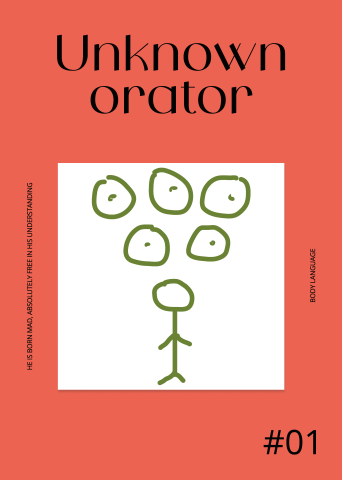
The process of thinking occurs in a certain rhythm as the brain focuses on a specific object of thought. To maintain this rhythm, a person can adopt one of two approaches: to delve into their thoughts in a safe static position or to demonstrate and stimulate mental activity through dynamic movements. Let's consider these two approaches of effective thinking in more detail, and how they manifest non-verbally.
Way one: immersion in thoughts
Sometimes, for productive reasoning, complete concentration on the subject of thought is necessary. This can be facilitated by the feeling of security and comfort that a person creates due to closed poses: for example, crossed arms and legs, lowered head, and gazing at one point. This is exactly what the image of Rodin's The Thinker appears before us – a sculpture that embodies a universal idea of a thoughtful person, understandable to representatives of different cultures.
Everyone has their favorite positions for deep contemplation. Some people think best in a chair or at a table, with their chin resting on their hand and staring at a single point. Others prefer to meditate while walking alone, listening to music on headphones and hiding their face in a hood to avoid unnecessary attention and distractions. Solitude and closed positions help to abstract from external stimuli and fully concentrate on the flow of thoughts.
Way two: active thinking
In contrast to static absorption, active thinking is accompanied by energetic gestures and movements that seem to reflect and stimulate the work of thought. At such moments, an irrepressible intellectual energy seems to pulse inside a person, seeking a way out. The eyes light up with enthusiasm, the hands are in constant motion: the person walks around the room, draws, writes, snaps their fingers, scratches his face, twirles various objects in his hands – in a word, they are completely absorbed in a whirlwind of their own ideas.
These spontaneous movements help to intensify the thinking process and set the rhythm and pace of mental activity, involving not only the brain, but also the whole body. Active gesticulation acts as a kind of external manifestation of internal mental work, during which ideas are formed, developed and transformed into new concepts and insights. In essence, it is a way to physically express abstract thoughts, to give them material embodiment.
Individuality of the thought process
Both described variants of thinking –static and dynamic – are completely organic and individual. The tendency to one or another style of thinking can be determined by the peculiarities of temperament, environment, physical and emotional state of a person at a particular moment. The main thing is to find the optimal rhythm for yourself and the conditions under which intellectual activity occurs most effectively.
It should be noted that the need for active gestures or solitude naturally arises precisely during the process of thinking, generating new ideas. But at the stage of presenting the finished results of thinking, especially with a motivational purpose, non-verbal behavior plays a different role. In this case, body language should emphasize key points, convey the speaker's confidence and competence, and not reflect his mental searches. However, during working reports and information messages, manifestations of focused thinking will be quite appropriate.
Red flags:
- Absent. Thinking justifies any gesture
Blue flags:
- Convenient, comfortable poses that promote concentration
- Active gestures that help intensify the thought process and maintain focus