How Thomas Mann Persuaded Germans to Turn Away from Nazism
A Voice from Across the Ocean
Thomas Mann (1875–1955), recipient of the Nobel Prize in Literature in 1929, was born in Germany, later emigrated to Switzerland following the outbreak of the Second World War, and subsequently settled in the United States. Together with his children, he took an unequivocal anti-Nazi stand and left behind a philosophical legacy of enduring significance.
In October 1940, Thomas Mann began producing a series of anti-Nazi radio addresses — Deutsche Hörer! ('Listen, Germany!') — for the BBC, organised largely through the efforts of his daughter, the BBC journalist Erika Mann. The broadcasts appeared monthly (fifty-five principal addresses in all, through to May 1945, alongside a number of special editions) and carried a counter-propaganda mission: to tell Germans the truth about the Nazi regime and its crimes against humanity.
From Writer to Orator
In the autumn of 1940, Mann initially wrote his texts and telegraphed them to London, where a German-speaking BBC staff member would read them on air. But he soon grasped something essential: the power of the orator — the power of persuasion through one’s own voice, through emotions that can only be conveyed in person.
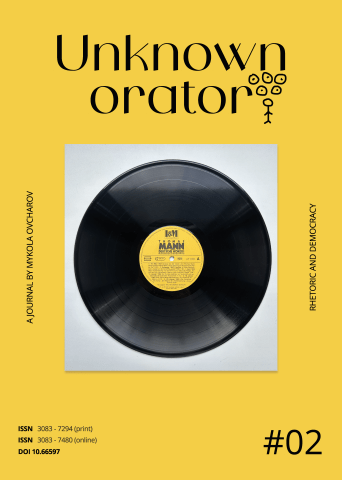
From 18 March 1941, at NBC’s recording studio in Los Angeles, he began personally recording his addresses onto gramophone discs. The discs were first dispatched to New York, then transmitted by telephone line to London, where the BBC broadcast them into Germany.
This was a decisive change. The only thing capable of penetrating the wall of information and propaganda that the Nazis had erected — a wall that towered high over Europe — was a radio signal carrying the voice of a moral authority from across the ocean. But that authority had to be personal, audible, and alive.
"GERMAN LISTENERS: What I had to tell you from afar, until now was brought to you by other voices. This time you hear my own voice. It is the voice of a friend, a German voice; the voice of a Germany which showed, and will again show, a different face to the world from the horrible Medusa mask which Hitlerism has pressed upon it. It is a warning voice."
In this moment, Thomas Mann presented himself not as a writer but as a public figure — as a German bearing a different face. His aim was to awaken empathy and to conjure the image of an alternative representative of a people that had inflicted such devastation upon Europe and the world. Rhetoric had become his most powerful instrument.
The Transformation of a Pacifist
Despite his pacifist and anti-war convictions prior to the Nazi seizure of power — when Mann had identified himself as an artist standing above the fray of political ideas and movements — the Second World War impelled him to take up the political megaphone. He began deploying a different register of thought: rhetorical, political, counter-propagandistic.
For, as noted in the preceding article on wartime rhetoric in Ukraine, the victim of aggression — whether a democratic state or an individual with democratic convictions — cannot respond with pluralistic rhetoric against an aggressor mobilised around a unidirectional, binary mode of thought and action.
And so, Mann’s rhetoric acquired an aggressive emotional charge: passionate judgements, the amplification of feeling, and at times outright anger.
Responsibility Before History
Mann’s addresses were an act of responsibility — responsibility towards himself, towards his people, and towards the society that had given rise to such suffering in others. This act exemplifies the conscience of a member of a society who stands against evil, against moral degradation, against crimes against humanity.
His example demonstrates the degree to which one can remain strong and accountable even when opposing a vast propaganda machine — provided one’s words have form, one’s life has depth of meaning, and one’s body of work carries cultural weight. In that case, one possesses a force and an influence that extends not only into the present moment, but into history and into the lives of future generations.
The Purpose of the Addresses: The Hope of Resistance
The purpose of his broadcasts was not only to counter official propaganda but to offer hope — hope in a resistance to the Nazi regime that was growing, that remained alive.
For those within Germany who were capable of opposing the Nazis, Thomas Mann reported on the mobilisation of American and British forces, on Lend-Lease, on military operations and the successes of the anti-Hitler coalition — with the express aim of piercing the veil of official propaganda, exposing its falsehoods and horrors.
An Appeal to Cultural Roots
He appealed to the moral qualities and values that had been cultivated within the German people over centuries. For he himself belonged to that people. He knew its history, its literature, its philosophy, its rich culture. He knew that he could appeal to the deep roots of their shared cultural foundation — and to their common sense:
"Can a nation live as bailiff of all the others, with policing armies all over the subjugated globe, while all nations do slave labour for the master race? Is that a moral possibility for any people, and especially for you Germans? One may think about history and mankind as sordidly and sceptically as one wants to, but that the world will recognize the ultimate victory of evil, that it would tolerate being turned into a single Gestapo cellar, a single concentration camp where you Germans would function as S.A. guards, not even the greatest unbeliever can believe."
"...I believe that nobody can feel as much horror of you as you must, after all, feel of yourselves."
A Rhetoric from Below, Not from Above
Thomas Mann did not address society from on high, as Goebbels and Hitler did. He spoke as one of his own — as a friend, a fellow traveler, as an equal to any member of the German people.
He sought to reach German consciousness from the other direction — from below, from the side of common humanity, of equality, of artistic empathy.
Though he, like Hitler and official propaganda, appealed to the roots of the German people, there was a fundamental difference: Hitler distorted those roots and manipulated them. Hitler appealed to blood and race — biological roots. Mann appealed to spirit and culture — intellectual and moral roots. Thomas Mann was himself a representative, a creation, a flowering of those roots — a genuine cultural fruit, recognised the world over.Though he, like Hitler and official propaganda, appealed to the roots of the German people, there was a fundamental difference: Hitler distorted those roots and manipulated them. Thomas Mann was himself a representative, a creation, a flowering of those roots — a genuine cultural fruit, recognised the world over.
He was a Nobel Laureate (1929), the author of Buddenbrooks, The Magic Mountain, and Joseph and His Brothers. A true representative of German culture — not the manufactured pseudo-elite of the Nazis, who merely draped themselves in culture to lend legitimacy to barbarism.
A Symbol of Defiance
Today, as the world confronts fresh manifestations of authoritarianism and the rhetoric of the far right and far left — as the spectre of dictatorship casts its shadow even over democratic nations — Mann’s speeches and his cycle of addresses stand as an exemplar of humanity, of defiance, of resistance.
A symbol of dignity, of humanity, of courage, and of the expression of the highest human values. And above all — of responsibility towards society and towards the world.
The Moral Mission
His work carried immediate practical value. For within Germany too there were acts of heroism — a small number of people who distributed anti-Hitler leaflets and dared to speak the truth. His broadcasts sustained those people.
But beyond this, the broadcasts carried a moral mission: to preserve whatever remained of the reputation of German culture, the reputation of the German individual as a member of the human community. To preserve the possibility of safeguarding something sacred and humane — something that had to survive in the world and in society, even in the darkest of times.
One can also discern in Thomas Mann’s work not a desire to wash the Nazi stain from German history, but a determination to preserve the very conscience he so fiercely defended — the conscience not only of a German, but of a human being:
"The so-called destruction of Germany is as empty a word, as nonexistent a thing, as the victory of Hitler. But the end is approaching; in fact, it will come soon — the end of the repulsive system, the robber, murder, and liar state of National Socialism. An end will be put to its trashy and disgraceful philosophy and all the acts of trash and disgrace which have sprung from it. Accounts will be settled, disastrously settled, with its bigwigs, its leaders and helpers, servants and beneficiaries, its generals, diplomats, and Gestapo hyenas. Accounts will also be settled with its intellectual trail-blazers and shield-bearers, the journalists and pseudo-philosophers who licked its boots, the geopoliticians, war geographers, teachers of 'Wehrwissenschaft' and race professors. Germany will be cleansed of all that ever had anything to do with the filth of Hitlerism and all that made it possible. And a freedom will be established in Germany and in the world which believes in itself, respects itself, knows how to defend itself, and which takes not only the deed but, before that, the thoughts into the control of those ideas which connect man with God."
A Lesson for the Present
Thomas Mann demonstrated that even when one’s own people have committed the most terrible crimes, even when the propaganda machine appears omnipotent, even when one finds oneself in the minority — the word of moral authority retains its force.
Not because it is guaranteed to vanquish evil here and now. But because it preserves the memory of humanity, of conscience, of responsibility — for those who are living now, and for those who will come after.
References
- Mann, Thomas. Listen, Germany! Twenty-Five Radio Messages to the German People over BBC. New York: Alfred A. Knopf, 1943.
- Mann, Thomas. Deutsche Hörer! Radiosendungen aus dem Exil 1940–45. Historische Original-Aufnahmen. Ed. Walter Andreas Schwarz. Leuberg Edition GmbH, CH-8615 Wermatswil/Zürich, 1987. L&M Literatur und Musik. Cat. no. LLP 18603 / LMC 28603. (Originally recorded 1941–1945 by BBC London; released by arrangement with BBC Enterprises Limited. Text © 1945 Bermann-Fischer-Verlag, Stockholm / S. Fischer Verlag, Frankfurt a.M.)
- Hutsch, Patrick. "The Voice across the Atlantic." Thomas Mann House / Deutschlandradio, 11 November 2025. Available at: https://www.vatmh.org/de/thomas-mann-house/thomas-mann-deutsche-hoerer-dlf.html
- High, Jeffrey L., and Elaine Chen. "The Coming Victory of Democracy." Goethe-Institut. Available at: https://www.goethe.de/prj/geg/en/aut/26664779.html