Body language: the key to effective communication
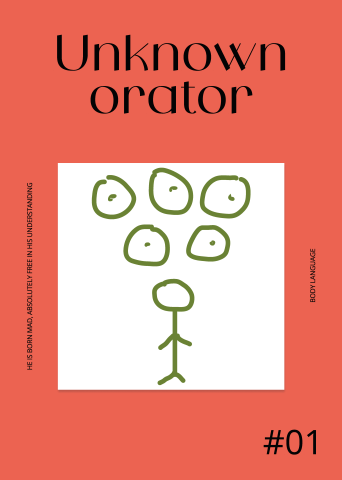
Nonverbal communication, or body language, is one of the oldest forms of communication, preceding the emergence of spoken language. Although the role of gestures has somewhat diminished with the development of verbal language, they continue to play an important role in our daily interactions. We constantly exchange information on an unconscious level through postures, facial expressions, body movements, conveying emotions and attitudes towards the interlocutor or situation.
Body language becomes especially important during important communication events, such as business negotiations, presentations, interviews, competitions, or conferences. In these situations, our nonverbal signals can become both a powerful ally and a dangerous enemy.
Let's look at a few examples.
Imagine you are giving a presentation to a large audience. If your gestures are appropriate and meaningful, i.e. they emphasize and illustrate key points, the audience will find it easier to perceive and remember the information. An open posture, confident movements, and eye contact will help establish trust and understanding with the audience.
Now let's simulate another situation. You have come to an interview and want to make the best impression on a potential employer. But because of your anxiety, your body involuntarily gives off signs of insecurity: you slouch, hide your hands, avoid the interlocutor's gaze. Even if your words are convincing, nonverbal signals may not work in your favor.
Why does this happen? The fact is that we unconsciously associate closed, defensive postures and chaotic, small gestures with fear, anxiety and weakness. Conversely, straightened shoulders, open palms, smooth movements evoke a feeling of calm, determination and competence. So, without even realizing it, we are constantly reading nonverbal signals and reacting to them.
Moreover, experienced communicators who are well versed in body language can receive much more information than we would like to convey. They notice the slightest changes in posture, breathing, facial expressions and draw their own conclusions based on this. That is why it is so important to learn the basics of nonverbal communication – to control your signals and use them to your advantage.
How to master this ancient, but still so relevant language? First of all, it is worth developing self-awareness. Pay attention to how you usually sit, stand, walk. What gestures do you use most often? How do you react with your body to different situations and emotions? Observing yourself will help you identify bad habits and replace them with more effective patterns of behavior.
It will be no less useful to study the nonverbal signals of other people. Try to read the emotional state of the interlocutor by his facial expressions, posture, gestures. Pay attention to how influential speakers use their bodies during speeches. Gradually, you will develop a "sixth sense" and will be able to better understand the hidden meaning of messages.
Of course, you should not underestimate the power of words and rely exclusively on body language. Ideally, verbal and non-verbal signals should complement and reinforce each other. Only a harmonious combination of all means of self-expression allows you to achieve maximum effect and mutual understanding.
So, body language is a powerful communication tool that we often use unconsciously. By understanding the principles of nonverbal communication and controlling our own signals, we can significantly increase the effectiveness of interaction in professional and personal spheres.
Study this fascinating science. Experiment with different techniques, analyze successful and unsuccessful cases. And remember that even the smallest gesture can have a great meaning. As the philosopher Friedrich Nietzsche wrote: "There is more intelligence in your body than in your best wisdom."
Red flags:
- Ignore the importance and influence of body language
- Underestimate the power of nonverbal signals
- Excuse inappropriate body language
Blue flags:
- Be aware of the role of body language in communication
- Study your own nonverbal patterns and analyze others
- Strive for a harmonious combination of verbal and non-verbal means of communication